
Raw Material Supplier in Saudi Arabia: Optimizing Sourcing and Procurement Strategies

What are the problems faced by businesses working with a raw material supplier?
Businesses working with a raw material supplier commonly face supply delays, price variations, quality issues, and communication gaps. Over time, these begin to affect production schedules, cost stability, and supplier reliability.
These problems don’t occur suddenly. They develop gradually—through minor delays, small quality variations, or repeated follow-ups that start impacting operations over time.
This is not a one-time issue; it is usually a symptom of deeper gaps in sourcing alignment and coordination.
In industrial environments, this pattern is consistently observed, where raw material sourcing outcomes are shaped more by process planning than by individual supplier performance.
Why does raw material sourcing break down in real operations?
Usually, raw material sourcing breaks down due to weak supplier validation and limited real-time visibility. However, over-dependence on a single raw material supplier and unstructured procurement processes are the major factors.
Suppliers are often selected based on unit price, while critical factors such as lead time consistency, material quality, and documentation readiness are not fully assessed.
A key gap comes from not paying enough attention to Total Cost of Ownership (TCO). Costs tied to delays, defects, and logistics often get missed, and that directly eats into margins and disrupts production stability.
But from an operational standpoint, when sourcing isn’t structured, these issues start affecting the procurement of raw materials. It becomes reactive. And over time, outcomes turn inconsistent.
What are the key challenges in global sourcing strategies?
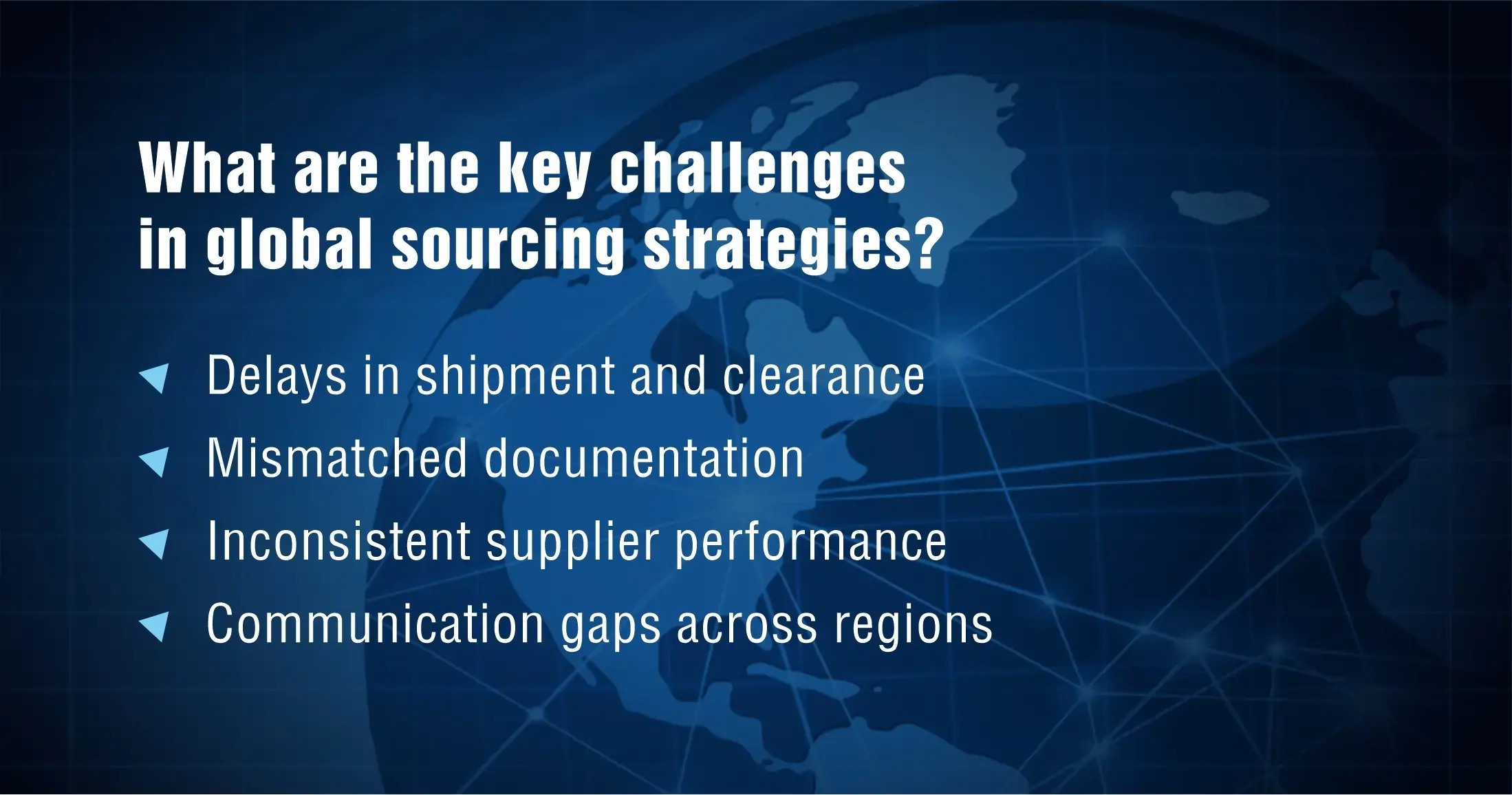
Global sourcing strategies bring a set of challenges—logistics delays, compliance gaps, supplier verification risks, and communication issues.
But while global sourcing strategies offer cost-effectiveness and access to multiple suppliers, execution often introduces uncertainty.
Common issues include:
1.Delays in shipment and clearance
2. Mismatched documentation
3. Inconsistent supplier performance
4. Communication gaps across regions
In Saudi Arabia, these challenges are closely linked to regulatory systems such as the SABER platform, ZATCA, and compliance requirements under the National Industrial Development and Logistics Program (NIDLP), which directly affect clearance timelines and sourcing flow.
So the effectiveness of global sourcing strategies comes down to supplier assessment, accurate documentation, and proper coordination across the supply chain.
How does procurement of raw materials impact overall business performance?
The procurement of raw materials directly affects cost control, production continuity, and product quality—especially when coordination with each raw material supplier is inconsistent.
At its core, procurement acts as the operational layer that connects supplier performance with production requirements.
When this coordination is weak:
1.Inventory gaps occur
2. Excess stock increases holding costs
3. Production delays impact output
4. Operational costs continue without alignment
And these issues usually trace back to gaps in planning, supplier coordination, and procurement structure.
In practice, effective raw material sourcing depends on how closely procurement decisions match actual operational needs.
What role do global sourcing strategies play in Saudi Arabia?
Global sourcing strategies give access to competitive pricing, specialized materials, and a wider supplier base.
But in Saudi Arabia, how well they work depends on how closely sourcing aligns with local conditions and supply chain realities.
Industrial activity is concentrated in hubs like Jubail, Yanbu, and Dammam, where logistics infrastructure and clearance timelines directly shape sourcing outcomes.
And as output grows, manual sourcing becomes harder to manage. This pushes businesses toward more structured, system-driven approaches.
So rather than day-to-day operational issues, global sourcing strategies define how supplier access expands while managing complexity—through supplier validation, logistics coordination, and consistent execution.
How can businesses improve raw material sourcing efficiency?

Improving raw material sourcing efficiency comes down to how consistently procurement decisions are executed across suppliers, timelines, and demand.
But in many cases, the same issues keep repeating because the underlying sourcing structure doesn’t change.
A structured approach typically includes:
1.Supplier validation before selection
2. Tracking supplier performance (lead time, quality, responsiveness)
3. Reducing dependency on a single raw material supplier
4. Aligning procurement with demand forecasts
5. Maintaining clear documentation for specifications and terms
So efficiency improves when sourcing is managed as a system—not by frequently switching from one raw material supplier to another.
Can ERP improve procurement of raw materials?
ERP systems improve visibility across the procurement of raw materials by bringing inventory, purchasing, and supplier data into one place.
But without ERP, managing multiple raw material supplier relationships becomes difficult and time-consuming.
With ERP:
Real-time visibility into inventory levels
Tracking and automation of purchase orders
Centralized supplier data and performance tracking
Support for demand-based planning and forecasting
Improved visibility into procurement costs and spending
>> So this reduces manual coordination and brings more consistency into sourcing operations.
But ERP doesn’t replace decision-making. If sourcing processes are unstructured, it only makes the gaps more visible—it doesn’t fix them.
In practice, ERP systems tend to expose weaknesses in sourcing processes rather than resolve them.
When should businesses consider external sourcing support?
External sourcing support becomes relevant when procurement issues move from isolated incidents to recurring patterns.
But the real signal isn’t just the presence of issues—it’s the lack of consistency in sourcing outcomes.
At this stage:
- Supplier performance varies across orders
- Procurement decisions depend on urgency rather than planning
- Cost variations become difficult to control
- Internal teams spend more time resolving issues than improving processes
>> This reflects a lack of consistency in how sourcing decisions are managed.
In the industrial sector, external support is typically considered when teams spend more time managing disruptions than improving sourcing outcomes.
At this stage, businesses typically engage a procurement sourcing specialist to bring structure to supplier validation, coordination, and sourcing decisions.
How Wavy Solutions Supports Structured Raw Material Sourcing
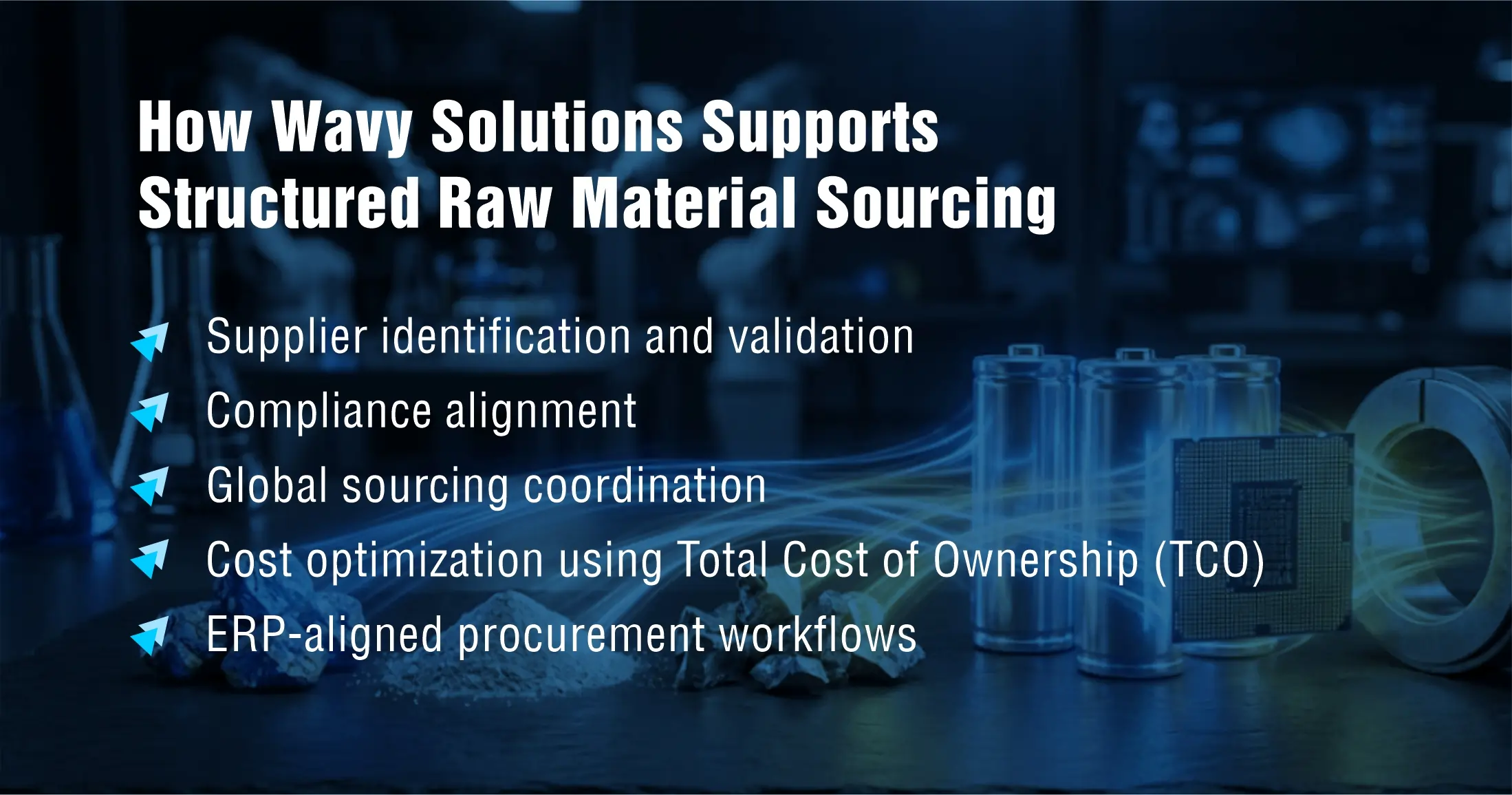
Sourcing performance gaps typically occur across supplier validation, coordination, and procurement structure.
These gaps are addressed through sourcing frameworks implemented by Wavy Solutions as a procurement sourcing specialist, with structured control across key stages of the sourcing process:
- Supplier identification and validation
Suppliers are screened based on capability, consistency, compliance readiness, and alignment with ethical and environmental standards to reduce dependency risks and quality issues. - Compliance alignment
Documentation, certification, and regulatory requirements are handled early to avoid delays and approval bottlenecks. - Global sourcing coordination
Supplier communication, logistics timelines, and material specifications are aligned to prevent mismatches and shipment disruptions. - Cost optimization using Total Cost of Ownership (TCO)
Sourcing decisions are evaluated beyond unit price, factoring in delays, defects, and logistics costs. - ERP-aligned procurement workflows
Procurement processes are structured to integrate with ERP systems, improving visibility, tracking, and demand alignment.
As raw material sourcing complexity increases—especially with supplier expectations influenced by the Iktva Program and logistics coordination linked to the Saudi Ports Authority (Mawani)—internal teams often shift from structured planning to reactive execution.
Our approach supports internal procurement teams by improving consistency, reducing uncertainty, and aligning raw material sourcing decisions with operational requirements.
From Supplier Dependence to Process Control
Sourcing performance doesn’t improve just by switching suppliers. It improves when decisions are structured and executed consistently.
And as supply chains become more complex, consistency comes from process control—aligning validation, coordination, and planning to reduce variability.
So structured sourcing isn’t an upgrade. It’s a shift—from reacting to disruptions to controlling outcomes.
Wavy Solutions applies this shift through structured sourcing execution, aligning supplier validation, coordination, and system integration to deliver consistent, scalable performance.
FAQ:
Q: How do you choose a reliable raw material supplier in Saudi Arabia?
A: A raw material supplier might quote well but still miss timelines or delay documents. What actually matters is consistency—on-time delivery, clean paperwork, and fewer follow-ups. And check how their last few shipments went. If clearance kept getting delayed or documents had issues, it usually repeats.
Q: Why is raw material sourcing failing for manufacturers in Saudi Arabia?
A: In most cases, it doesn’t fail all at once. It builds up. Small delays, last-minute supplier changes, or incomplete documentation start stacking over time.
But once that pattern sets in, raw material sourcing turns reactive. Teams stop planning and start fixing problems. That’s where costs and delays begin to repeat.
Q: What are the biggest risks in raw material procurement today?
A: The biggest issue is losing visibility. When you don’t know what’s delayed, what’s approved, or what’s in transit, decisions slow down.
And relying on one supplier makes it worse. One delay, and the whole schedule shifts. It happens fast.
Q: How do you audit a raw material supplier for Saudi compliance?
A: Start with the basics. Check certifications like ISO or ASTM. Then confirm ZATCA requirements are in place. But also verify if approvals are registered in SABER before shipment. If not, delays at clearance are almost guaranteed. No workaround there.
Q: How can global sourcing strategies reduce supply chain risk?
A: Spreading sourcing across regions gives flexibility when something goes wrong. But coordination matters. Without it, even global sourcing strategies can create confusion instead of reducing risk.
Q: Can ERP improve procurement efficiency in Saudi industrial hubs?
A: Yes, ERP gives visibility—inventory, purchase orders, supplier data—all in one place. But if the underlying process is messy, ERP just shows the gaps faster. It doesn’t fix them.
Q: How can Saudi businesses manage raw material price volatility?
A: Over time, this comes down to planning. If purchases happen at the last minute, price swings hit harder.
And working with more than one supplier helps balance risk. Not perfect, but it gives room to adjust.
Q: What role does NIDLP play in Saudi industrial sourcing?
A: NIDLP focuses on improving infrastructure and logistics across industrial zones.
As transport and clearance become more predictable, raw material sourcing also becomes easier to manage. Not faster every time—but more stable.