Industrial

Saudi Arabia’s industrial sector is no longer operating in a low-risk, trial-and-error environment. Industrial leaders today are expected to deliver faster project execution, tighter cost control, consistent quality, and long-term operational sustainability all while navigating capital-intensive investments and evolving market conditions. For factory owners, project directors, operations managers, and investors, the margin for error has become extremely small.

In this environment, relying purely on internal experience or fragmented advice often leads to delays, cost overruns, inefficient plant performance, and missed growth opportunities. This is why industrial consulting services in Saudi Arabia have become a critical support system for organizations that want to make confident decisions, reduce risk, and build industrial operations that can grow effectively. 

This guide explains how industrial consulting works, why it matters in the Saudi context, and how businesses can use it to achieve long lasting industrial growth.


Introduction: Why Industrial Consulting Matters in Today’s Saudi Industrial Landscape

Industrial projects in Saudi Arabia are growing in size, complexity, and strategic importance. Whether it is a new manufacturing facility, plant expansion, industrial modernization, or operational turnaround, every decision carries long-term financial and operational consequences. At the same time, industries are facing rising input costs, supply-chain pressures, tighter timelines, and increased expectations for efficiency and compliance.

Industrial consulting helps organizations bring structure and clarity to this complexity. Instead of reactive problem-solving, businesses gain access to structured analysis, technical expertise, and proven methodologies that support smarter planning and execution. Industrial consulting is not about theoretical recommendations; it is about enabling decisions that work on the factory floor, not just on paper.


What Are Industrial Consulting Services?

Industrial consulting services are specialized advisory and technical services designed to support industrial organizations in planning, developing, and optimizing their operations. These services focus on real-world industrial environments such as factories, processing plants, warehouses, and large-scale production systems.

Unlike general business consulting, industrial consulting is deeply rooted in:

  • Industrial engineering principles
  • Manufacturing and production systems
  • Operational efficiency and cost control
  • Technical feasibility and execution planning

Industrial consulting services typically include industrial development planning, engineering assessments, operational diagnostics, project planning, procurement support, and performance improvement initiatives. In Saudi Arabia, these services are tailored to local operational realities, infrastructure conditions, and market dynamics to ensure practical and implementable outcomes.


Why Industrial Consulting Services Are Critical in Saudi Arabia

Industrial projects in Saudi Arabia often involve high capital investment and long-term commitments. Decisions related to site selection, capacity planning, machinery sourcing, and process design directly impact operating costs, productivity, and profitability for years to come.

Without expert industrial consulting support, businesses commonly face:

  • Overestimated demand or underutilized capacity
  • Inefficient plant layouts and process bottlenecks
  • Cost overruns due to poor planning or vendor misalignment
  • Delays caused by unrealistic timelines
  • Quality and consistency issues during scale-up

Industrial consulting services help mitigate these risks by introducing structured evaluation, technical validation, and data-driven decision-making. This enables organizations to move forward with confidence, knowing that their industrial strategy is grounded in feasibility and operational reality.

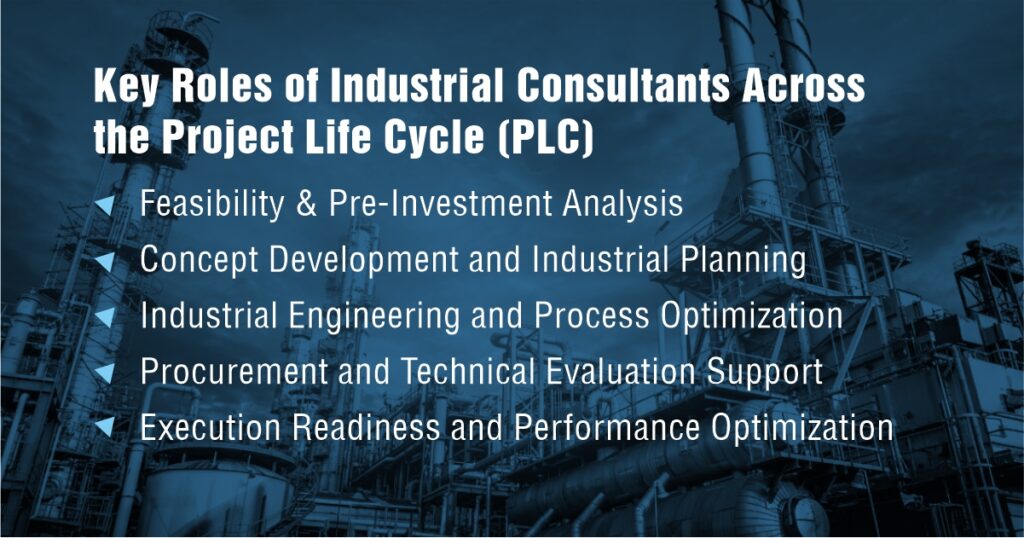
Key Roles of Industrial Consultants Across the Project Life Cycle (PLC)
Industrial Consultants in saudi arabia

Industrial consultants play a vital role throughout the entire project life cycle (PLC), supporting organizations from early-stage decision-making through execution and ongoing performance improvement. Their involvement ensures that industrial projects are planned realistically, executed efficiently, and optimized for long-term operational success.

Rather than focusing on a single phase, industrial consulting services provide structured guidance across multiple stages of an industrial project, helping businesses reduce risk and make informed, data-driven decisions.


Feasibility & Pre-Investment Analysis

One of the most critical roles of industrial consultants begins at the feasibility and pre-investment stage. At this phase, consultants help organizations evaluate whether an industrial project is technically feasible, commercially viable, and operationally sustainable. 

This includes assessing demand assumptions, high-level production capacity, cost structures, potential risks, and overall project readiness. Early feasibility support allows decision-makers to validate ideas before committing significant capital.

Concept Development and Industrial Planning

Once feasibility is established, industrial consultants support concept development and industrial planning. This involves defining production strategies, capacity planning, technology selection, and high-level plant configuration. The goal is to align business objectives with realistic industrial capabilities and ensure that early planning decisions support long-term scalability.

Industrial Engineering and Process Optimization

Industrial engineering consulting services focus on optimizing production flows, equipment selection, plant layouts, and resource utilization. By addressing these elements early in the project life cycle, industrial consultants help eliminate inefficiencies before they become embedded into operations, saving time and cost during later stages.

Procurement and Technical Evaluation Support

Industrial consultants also play a key role in procurement and technical evaluation. They assist organizations in evaluating machinery, equipment, and supplier options based on performance, reliability, lifecycle cost, and operational suitability. This structured approach reduces procurement risks and helps avoid costly sourcing and commissioning issues.

Execution Readiness and Performance Optimization

As projects move toward execution, industrial consultants ensure that systems, processes, and teams are fully prepared for implementation. After commissioning, they support performance optimization by identifying productivity gaps, quality improvement opportunities, and cost-efficiency measures, helping organizations achieve stable and efficient operations.


Industrial Consultant vs EPC Contractor: Understanding the Difference

Industrial projects often involve both industrial consultants and EPC contractors, but their roles are fundamentally different.

An industrial consultant provides independent advisory support focused on planning, optimization, and risk reduction. Consultants represent the client’s interests and help define requirements, evaluate options, and ensure technical and commercial feasibility.

An EPC contractor, on the other hand, is responsible for engineering, procurement, and construction execution based on an agreed scope.

Engaging an industrial consultant before or alongside an EPC contractor helps ensure that the project scope is well-defined, risks are identified early, and execution proceeds smoothly without costly redesigns or delays.


When Should You Hire an Industrial Consultant?

Industrial consulting services add the most value when engaged early, but they are equally effective during operational challenges. Common situations where industrial consulting is beneficial include:

  • Planning a new manufacturing or industrial facility
  • Expanding or modernizing existing plants
  • Addressing recurring operational inefficiencies
  • Improving productivity and quality performance
  • Evaluating new machinery or production technologies
  • Managing complex industrial transformation initiatives

Early engagement allows organizations to prevent issues rather than react to them after costs have already escalated.


How Industrial Consulting Drives Cost, Quality, and Time Efficiency

One of the strongest advantages of industrial consulting services is their ability to improve performance across cost, quality, and time simultaneously.

Cost Optimization

Industrial consultants identify inefficiencies, reduce waste, optimize procurement strategies, and improve resource utilization resulting in sustainable cost reductions rather than short-term cuts.

Quality Improvement

Through standardized processes, improved controls, and system optimization, industrial consulting helps reduce defects, improve consistency, and strengthen compliance with quality requirements.

Time Efficiency

Well-structured planning and execution reduce delays, improve coordination, and enable realistic scheduling ensuring projects and operations stay on track.

These combined benefits translate into stronger profitability and long-term operational stability.


How to Choose the Right Industrial Consulting Partner in Saudi Arabia

Selecting the right industrial consulting partner is a strategic decision. Organizations should assess consulting firms based on:

  • Proven industrial and engineering experience
  • Understanding of Saudi industrial environments
  • Practical, execution-oriented methodologies
  • Clear deliverables and transparent communication
  • Ability to support projects beyond advisory stages

Avoid partners that rely solely on generic frameworks without demonstrating hands-on industrial expertise.

Why Wavy Solutions for Industrial Consulting Services in Saudi Arabia

Industrial Consulting Services in Saudi Arabia


Wavy Solutions offers comprehensive industrial consulting services in Saudi Arabia, supporting businesses across diverse industrial sectors. With a strong focus on practicality and execution, Wavy Solutions helps organizations:

  • Plan and develop industrial projects with confidence
  • Optimize production systems and operational performance
  • Reduce technical and commercial risks
  • Build scalable, efficient industrial operations

By combining industrial engineering expertise with market insight, Wavy Solutions supports clients from planning through execution and long-term optimization.


Frequently Asked Questions (FAQs) About Industrial Consulting Services in Saudi Arabia

What is an industrial consultant?
An industrial consultant is a professional advisor who helps industrial organizations improve planning, operations, efficiency, and project outcomes.

What does industrial consulting include?
Industrial consulting includes industrial development planning, engineering support, operational optimization, procurement guidance, and execution readiness.

What is consulting in industry?
Consulting in industry involves providing expert guidance to improve industrial systems, processes, and performance.

What does industrial development mean?
Industrial development refers to the structured growth and optimization of industrial capacity, infrastructure, and operational efficiency.

What does a consultancy service do?
A consultancy service analyzes challenges, recommends solutions, and supports implementation to improve performance and decision-making.


Driving Industrial Success with the Right Consulting Partner

Industrial consulting services are no longer optional; they are essential for businesses seeking sustainable growth, operational efficiency, and risk-controlled execution in today’s competitive industrial environment. As industrial projects become more capital-intensive and complex, the cost of uninformed decisions continues to rise.

By partnering with an experienced industrial consulting firm, organizations can ensure that critical decisions are backed by technical expertise, market insight, and structured planning. The right consulting partner helps businesses reduce uncertainty, optimize resources, and create industrial operations that are scalable, efficient, and resilient over the long term.

In Saudi Arabia’s rapidly evolving industrial landscape, organizations that invest in expert industrial consulting services are better positioned to deliver successful projects, maintain operational excellence, and achieve long-term industrial growth with confidence.


Imagine a Japanese company ‘TechBrill’ makes super cool gadgets in Japan and they now think of opening a store in a new country Brazil. Well, they are not sure whether the people of Brazil will like the product. They need to ensure first and hence they go for a feasibility study service. This check will help them peep into the different nuances of business and make them aware of where they need to adjust to the situations to make the gadget go success in Brazil. It is just like planning ensuring everything works well.

The said process is called a feasibility study service for business. This study helps any company to figure out the best strategies that need to be applied to make the project a success. In 1996, Mcdonald’s hire a feasibility study service for figuring out the strategy to establish its business in India after it got a huge success in the USA.

The article will be a goldmine for you if you are looking for the steps and the process involved in conducting a feasibility study for your business. So let us first understand the exact meaning of feasibility study service.

What is a Feasibility Study?

Business leaders need to figure out the project viability before making long-term investments. Thorough research is needed & different things that impact the project are taken into account. The project could be like starting a business, expanding an existing business, or introducing new products. A lot of things need to be considered such as technical stuff, where the money comes from and where should it go, and much more.

Feasibility study service for business is a big deal that includes analysis from someone starting a new business or maybe running a small one. It is a process that shows people how would the business go in both scenarios.

Feasibility study service for business

7 Steps Undertaken to Conduct a Feasibility Study for Your Business Idea

Now let us look at the crucial steps that are involved to carry out a feasibility study:

1. Business Idea Analysis

A feasibility study begins with determining and explaining your company concept. This entails comprehending the problem that your company wishes to resolve for its clients. You must determine whether more customers desire your product or service than there are available. You should also determine what makes your company unique.

At this step, you’re determining if your company can, in principle, produce enough money to pay expenditures and turn a profit in the future.

2. Estimation of the Incomes Earned

Consider it like figuring out how extraterrestrial technology works. You start by determining how much money you want to generate from your business in a year. Then you calculate how much money you’ll need to get started or accumulate to make that amount of money. It’s like putting together a fascinating puzzle.

3. Market Research

This stage is critical in your feasibility study for the industrial project because it allows you to make an educated prediction about how much money you could make. It considers who lives there, what other businesses are doing, how much people would want to buy your item, and how unsafe things are. It also determines how much of the market you might grab and if you could expand in the future.

After doing some market research, you should have a good idea of where to start. However, making educated assumptions and studying the market is insufficient to determine if your concept will succeed.

4. Operations and Resources Planning

Now, in this section, you consider all the money you’ll need to operate operations and items you can’t avoid spending money on, such as equipment, workers, and the cost of the location where you’ll set up shop. This allows you to make key decisions, such as how you’ll deliver your sandwiches or which website platform is reliable for your online business.

5. Making Financial Statements

Absolutely! According to a feasibility study, you should construct a balance sheet even before you start your firm. This chart indicates where your company’s money originates from, what you own, and how much it’s worth. It also shows what you owe money for, such as rent or the purchase of land, buildings, and equipment.

6. Review and Analysis

Giving things a reality check is quite useful. Because there are so many unconfirmed estimations and statistics, they may not all agree. For example, your money statement may reveal completely different information about your company than your overall financial picture. Before you start a business, you should ask yourself a few questions, such as: Does this sound realistic? Should I have a backup plan in case something goes wrong? Hence, a feasibility study for an industrial project will give you a fair chance to review, analyze and think about whether to convert your idea into a reality.

7. Final Decision-Making

So, once you’ve completed all the preceding procedures, you must make one final critical decision. They do a few more inspections before making a decision. They consider whether the proposal is truly worth the time, money, and effort. They also ensure that the proposal aligns with what the organization wants to achieve and stands for.

Feasibility study for industrial service

Conclusion

If you have a great company concept and want to convert it into a reality, you should do a feasibility study for industrial service or for that matter any sort of industrial project. Spending money on a firm that fails in any of the methods described would be a huge and costly mistake!

If you currently have a firm and want to expand or add new features, a feasibility study may help you determine whether your plans will work and be profitable.

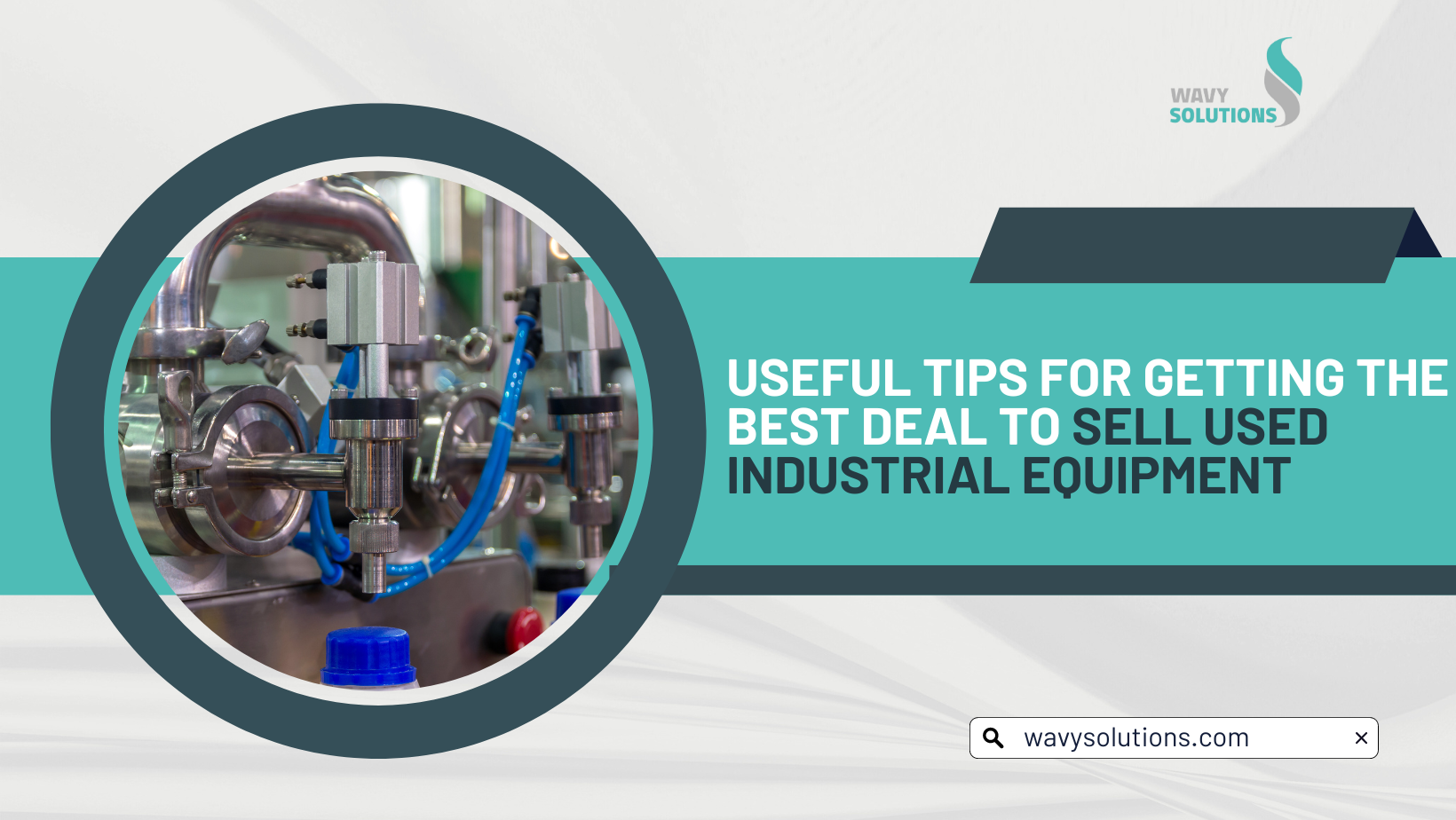
Seeking optimal value when trading pre-owned machinery is a common goal. Some people aim to get the best deal possible for Sell used industrial equipment, while others are content to settle for what is regarded as appropriate.

Reap Value from Used Industrial Equipment Sales

Are idle industrial assets taking up space? It’s time to unlock their hidden potential. Selling used industrial equipment not only declutters your workspace but also injects newfound capital into your operations. Our platform simplifies the process, connecting you with interested buyers seeking cost-effective solutions. From machinery to tools, your surplus items can find a new lease on life. Join our network today and turn unproductive assets into revenue-generating opportunities. Embrace efficiency, sustainability, and profitability – sell your used industrial equipment with us.

Interestingly, those sellers who get the most out of such deals for their previously owned machinery collaborate with dedicated heavy equipment seller, who can harness their expertise to maximize returns.

Instead of investing significant time, effort, and resources into self-research on the optimal sales strategy for your used machinery, here’s a valuable insight: Enlisting the support of a specialized machine sourcing solutions provider can considerably improvise your selling process.

We have curated some of the best and most valuable tips for you before you embark on a journey to find the surest deal for selling your pre-owned or used industrial equipment.

Useful Tips for getting the best deal to sell used industrial equipment at your business premises:

1. Assess Current Equipment Value

When you decide to sell used industrial equipment, your primary objective should be to make a successful deal. Along with seeking a better outcome, understand the importance of being realistic about the actual price your equipment can fetch. Getting well acquainted with the present value of your equipment can help you reinforce a specific price range that will encourage potential buyers to look forward to your deal. Moreover, this strategy will position you to drive interested buyers who are eager to get your machinery.

If you find yourself short on time to do thorough market research, you can still relax. You have another option of reaching out to experienced professionals who are heavy equipment seller experts. They are knowledgeable about the used equipment industry and can help you choose the ideal pricing range for your pre-owned items.

2. Provide Comprehensive Machine Details

When you are ready to sell used industrial equipment, think of potential buyers like people who want a range of details that will help them agree to the price you’re hoping for your machinery.

Put yourself in buyer’s shoes and try to figure out what info buyers will need about your used equipment.

But hey, we get it – you might be completely occupied and may lack enough time and attention to gather all the info about your equipment. So here are the things that most of the buyers look for: owner’s manual, spec sheets, maintenance history, repair records, and any other important documents related to the machine you’re selling.

In addition, keep things clear and be honest when describing your equipment. This will speed things up and you will potential buyers getting interested faster. Therefore, share details like how old your machine is, its name and model, the kind of work it’s done before, and its current condition – especially if you’ve replaced any major parts.

3. Enhance Equipment Presentation

Are you finding the right deal that can give you more money for your pre-owned equipment? Here’s the trick: consider giving it a makeover. Refurbishing your equipment could be as simple as giving it a thorough cleaning. Transform it into one of the best-looking and well-maintained machines. After all, how it looks can affect the buying decisions of your prospects as they always want to know more about your machine.

If you are really planning to maximize your returns from your extra machinery, you might want to take things further. Fixing things like broken glass, putting on new decals, or layering it with a fresh paint coat can make your equipment really appealing to buyers. And on the other hand, if you’re really short on time for all this – you can connect with a well-known heavy equipment seller who can help you with these tasks.

Once everything is spruced up, click good pictures of your equipment from different angles as the potential buyers need more convincing presentation of your equipment and would like to understand if it the pricing is worth it according to described features.

4. Craft Compelling Descriptions

In a crowded market where lots of people sell used industrial equipment, you must be extraordinarily good by writing an interesting and attention-grabbing description of your machine. This will entice people who are looking for good machinery and they will want to learn more about what you’re selling.

As more people get interested to see your machinery, there are more chances of finding a buyer quickly. To enhance your descriptions, do not forget to mention the important details about the machine. Inform the key speciality and most important advantage of your machinery– this will make the buyers more aware and will help them in being decisive.

Advertising may seen costlier for many of you who are in the beginning stage of the selling process.  So spend your money wisely ensuring you’re confident that you’ll get good results. Frequently, running ads on two distinct websites is a wise move. By doing this, your machine will be seen by more people, increasing the likelihood that it will sell.

5. Include Visual Media

Make certain to add images that correspond to the text when describing your machine. This makes it easier for users to rapidly comprehend the machine’s appearance and state. Include 4-6 images taken from various perspectives, and zoom in on key areas for a clear look. Use realistic images that are of a good grade. A quality video of the machine added to your listing can enhance it. You may use music for commercial purposes under this license as long as you provide due credit to the author.

6. Select Appropriate Marketplace

Selling pre-owned industrial equipment is a lucrative business. Companies that deal in old machinery typically specialize in specialized areas. If you want to sell machinery used in manufacturing and packaging, then you must hunt for buyers in a related area. Avoid seeking for buyers in public because finding buyers in a given category is easier and faster.

Heavy Equipment Seller

Wavy Solutions: Your ideal choice for reliable machine sourcing solutions!

If you’ve followed these recommendations so far, you should be able to get a great price on secondhand industrial gear.

If you have any more queries or want clarification, please contact us or visit our website at www.wavysolutions.com. We’re happy to answer any questions you have about selling your old industrial gear. We can assist you. Our trustworthy partners offer the greatest prices on a wide selection of used, new, and heavy mechanical equipment. Wavy Solutions provides premium services for acquiring machinery from reputable dealers in a simple and secure manner.

The core operations of every organization are taking a transformative shift with the evolving cultural changes. Along similar lines, the pharmaceutical sector is gradually demonstrating adaptability and is getting equipped with sound knowledge that can meet market demands and present transformations. The new trend facilitating this shift is the adoption of robust training and development strategies that can design powerful pharmaceutical management courses enabling pharma personnel to acclimate to an ever-changing work milieu.

With the exponential growth path paved for the sector, it has become essential that both new and existing employees are well-trained. Consistent and ongoing training is essential, as each employee must develop a comprehensive industry skill set and adapt to evolving trends. This holistic approach keeps them aligned with the industry’s upward trajectory while they can sharpen their skills along the way.

We cover some essential elements that all types of pharmaceutical training courses must have to empower the pharmaceutical industry in thriving to achieve its goals and objectives.

Pharmaceutical Training Courses

Incorporating Essential Elements Into Pharmaceutical Training Courses

Every customized training solutions provider must majorly focus on three key aspects while designing a training program. One is about general skills such as anatomy, drugs, and diseases. The second is about sales including communication skills, sales techniques, rejection handling, and patient care. And the third is about compliance knowledge regarding sales codes, adverse event reporting, and privacy regulations.

Pharmaceutical management courses must be created and formulated keeping in mind these aspects and the below-mentioned features:

1. Simplifying Learning Paths for Easy Comprehension

Training leaders in the pharmaceutical solutions industry should design training courses that primarily focus on the current needs of learners. For instance, creating courses as per the learners’ preferred training method can significantly improve their capacity to practically implement the training into their packed schedules.

Nevertheless, it may become a challenge to accommodate various learning necessities of diverse audiences spanning various qualifications, job functionalities, cultural contexts, and hierarchies. A basic, predictable, user-friendly, localized training regimen in the pharmaceutical solutions business, with fewer complicated learning paths, is expected to result in a significant percentage of course completion.

2. Embracing Simplicity Over Extravagance to Enhance Engagement

When it comes to Pharmaceutical Training Courses, industry experts specifically lean away from training materials that focus excessively on gamification, animations, or elaborate voice-overs. They consider it as an external motivational factor that holds lesser appeal for dedicated learners who look forward to training as a crucial part of their mission in improving their proficiency. A minimalist, straightforward, and efficient design approach will resonate more with these learners fostering higher engagement.

3. Bite-sized Mobile Learning: Modules of 5-10 Minutes

The pharmaceutical solutions industry experts consider designing courses that can offer device flexibility and universal access. Nowadays, content designed for mobile devices can be formulated and centered around a singular pharmaceutical concept so that it can enhance retention and minimize distractions for learners. Keeping an uncluttered layout that highlights the key elements is more advisable as it comprehensively covers vital information within a limited timeframe.

4. Customized Training Modules Aligned with Job Responsibilities

Every pharmaceutical professional must have a foundational understanding of the industry, however, the scope of knowledge differs from person to person. Experts can design pharmaceutical training courses and modules that aim for specific job roles allowing exclusive coverage of relevant subjects and topics and removing irrelevant content.

For example, there are different training requirements for a sales manager and a marketing manager. Their roles diverge significantly, despite sharing some information needs. One needs to design customized pharmaceutical management courses for a marketing manager who aims to focus on the medicine’s consumer-oriented highlights that should be appealing. And in contrast, a sales representative would need in-depth insights into various attributes such as to facilitate pitching the drug to medical practitioners and retailers.

5. Swift Development to Meet the Needs of Agile Learners

The pharmaceutical industry has several rules that are always changing. Because of these developments, pharmaceutical job training courses must be often revised, sometimes immediately before they are given.

For example, when new drugs or treatments are offered swiftly, new training sessions or classes for pharma employees must be developed quickly.

6. Assessing Progress through Goal-oriented Performance Evaluations

Training courses are regarded incomplete if they do not contain a method to test what you’ve learned. Goal-based evaluations serve as objectives for each stage of training, allowing you to know what to aspire for. When you complete a program, receiving a certificate might help you feel more accomplished and involved.

Customized Training Programs Provider

Conclusion:

The pharmaceutical industry is evolving at great speed. It’s becoming more flexible, digital, and teamwork-focused. This means that people working in the pharmaceutical field need special training to handle these changes. That’s where Wavy Solutions comes in. We are the top pharmaceutical solutions industry provider and are experts in creating training programs for the pharmaceutical industry. Our courses are made just for the people in this field, so they give you the exact knowledge and skills you need for pharmaceutical management, following rules, and the pharma industry in general.

We are a customized training program provider and our training is easy to use on mobile devices, and we make sure it fits your specific job. In addition, we can make it work for people all over the world. If you’re in the pharmaceutical business, pharmaceutical management courses and other pharmaceutical training courses can help you stay ahead. Check out our website at www.wavysolutions.com to learn more about the different courses we offer for pharmaceutical training.

FAQs for Customized Pharmaceutical Training Programs:

1. What is a customized training program provider?

A customized training program provider is a specialized organization that tailors educational content and experiences to the specific needs and requirements of individuals or companies in the pharmaceutical industry. These programs are designed to address unique challenges and enhance skills within the context of pharmaceutical management and operations.

2. How do customized training programs differ from standard pharmaceutical training courses?

Customized training programs stand out by offering personalized curriculum development, flexible scheduling, and targeted content delivery. Unlike standard pharmaceutical training courses, customized programs are adaptable to the specific goals and objectives of the participants, making the learning experience more relevant and effective.

3. What are pharmaceutical management courses?

Pharmaceutical management courses are educational offerings that focus on developing leadership, strategic planning, and operational skills within the pharmaceutical industry. These courses cover various aspects, such as regulatory compliance, supply chain management, marketing strategies, and ethical considerations, to equip professionals with the expertise needed to excel in managerial roles.

4. How can pharmaceutical training courses benefit professionals in the industry?

Pharmaceutical training courses provide professionals with up-to-date knowledge, industry insights, and practical skills required for successful careers in the pharmaceutical solutions industry. These courses help participants stay informed about evolving regulations, cutting-edge technologies, and best practices, enabling them to make informed decisions and contribute effectively to the sector.

5. What role does the pharmaceutical solutions industry play in healthcare?

The pharmaceutical solutions industry plays a critical role in healthcare by researching, developing, producing, and distributing medications and therapies to prevent, treat, and manage various health conditions. It encompasses pharmaceutical manufacturers, researchers, regulatory agencies, and other stakeholders working collaboratively to ensure the safety, efficacy, and accessibility of pharmaceutical products worldwide.


Every industry thrives with new technologies and innovative methods to provide products designed, manufactured, and serviced faster with the highest quality. Thanks to so digitally transformative techniques and efficient industrial development services that are supporting companies to make products.

How Industrial Development Services Can Help Your Business Growth?

Industrial development is not just confined to providing high-quality products at lower costs. With digital transformation and the best industrial engineering services, the world is moving faster with a drive to restore the intelligence of products with great efficiency through great supply chains. This can only amplify the growth of any product. The blog discusses five ways in which product development is rapidly and consistently evolving to meet these goals.

Digital transformation is changing the way products are developed, manufactured, and delivered. Industrial development services are at the forefront of this transformation, using digital technologies to create new and innovative products. Industrial development are a broad range of services that help businesses develop new products and improve existing ones.

Industrial Development Services

5 Ways Products Are Developing With Industrial Development Services Powered by Digital Transformation

1) Speed and Agility

Speed becomes the ultimate focus for many companies. Whether they are trailblazing new market frontiers, launching breakthrough product ideas, or striving to keep up in rapidly evolving industries like retail, time is of the essence in the world of industrial development.

To meet this need for agility, such companies seek tools that embrace digitalization in the product development process. These tools streamline collaboration with current suppliers and facilitate seamless onboarding of new ones, ensuring that their innovative products hit the market precisely when the timing is ripe.

2) Digital Threads to Pursue Profitability

For companies with a diverse range of products in the market, finding the right balance between growth and profitability is crucial. They need to maintain both speed and efficiency to thrive. This becomes possible for every company by collaborating with proficient industrial development services.

When product information is reused and different versions and configurations are interconnected to allow for traceability and change control, it creates a model-based digital thread. This thread begins in the digital realm with planning, requirements, and system engineering. It then progresses to engineering, testing, and validating the product concept, and finally, it reaches the manufacturing stage where the digital product concept is transformed into a physical product.

Once the end customer receives and starts using the product in the real world, the manufacturer closely monitors its performance to ensure it delivers its full value and timely support. The process helps gain insights forming a closed-loop feedback system. These insights inform problem reports and engineering change orders, leading to continuous improvements in product design & manufacturing processes. As a result, a new and enhanced model or version of the product emerges, and the whole cycle begins again.

3) Sustainability is Prime Focus

The choices made during the product design phase are crucial for overall industrial development and for the company itself. Such choices have accounted for approximately 80% of the overall footprint. Once these decisions are finalized, it becomes challenging to make substantial changes later.

To make a remarkable difference in your company’s environmental impact, you need to influence the decisions made in the digital realm, which will subsequently lead to improved outcomes in the physical world.

Ensuring sustainability is just one aspect of the many regulatory requirements that companies must adhere to. There are various industries and companies which deal with safety-critical devices and software and rely on industrial development services that provide guidance and support for meeting different industrial standards and global regulations. Companies that can effectively incorporate compliance into the product development process, are sure to succeed.

4) SaaS Transition

Enlisting the assistance of an industrial project consultant is essential if you want to easily, rapidly, and efficiently revamp your organization through digital transformation. They may introduce you to the latest technology that you receive as a service, keeping you one step ahead of the competition.

Industrial development services are now adopting a variety of strategic techniques to breathe life into Software as a Service (SaaS) across various digital thread products.

Imagine a team of engineers from across the world analyzing and merging one another’s improvements into a single design. They can branch designs to investigate various options and then carefully combine the most promising components. This is only one of the several benefits that SaaS offers.

5) Reliable Partnerships

Establishing strong and enduring partnerships is crucial for long-term success. It is this very reason that compels us to adopt a customer-centric approach, resolving intricate challenges across diverse industries and around the globe.

For over a decade, Wavy Solutions has consistently served as a strategic partner for numerous organizations. We have meticulously crafted strategies that facilitate a fundamental shift in decision-making, moving it earlier in the product design process. This empowers customers to harness the benefits of design guided by valuable insights, leading to faster time-to-market and enhanced product quality.

As highly regarded industrial project consultants, We strive to meet our customers at their current stage and assist them in transforming into what they aspire to become in the future.

Industrial Project Consultant

Final Thoughts

We are futuristic industrial development service providers with a strong presence in evolving the best business brands in the world. With our ultimate expertise, we have a large number of satisfied clients with higher retention ratios. At your disposal is a team of highly skilled industrial experts, renowned in their field. Visit our website wavysolutions.com to know more about our widest range of industrial development services.

FAQs for Industrial Development Services:

1. What are Industrial Development Services?

Industrial Development Services encompass a range of specialized solutions aimed at optimizing and enhancing industrial processes, systems, and projects. These services often include industrial engineering, project management, and consultation to drive efficiency, productivity, and innovation.

2. How does industrial development contribute to economic growth?

Industrial development involves strategic initiatives to promote the growth of various industries within a region. By fostering innovation, increasing production capacity, and creating job opportunities, industrial development contributes significantly to overall economic growth and prosperity.

3. What are industrial engineering services?

Industrial engineering services involve the application of engineering principles to improve the efficiency and effectiveness of industrial processes. These services analyze workflows, optimize resource allocation, and implement solutions to streamline operations and reduce costs.

4. Why hire an industrial project consultant?

Hiring an industrial project consultant brings specialized expertise to the planning, execution, and management of industrial projects. Consultants offer insights into best practices, risk mitigation strategies, and cost-effective approaches, ensuring the successful completion of complex projects.

5. How can industrial development services benefit my business?

Industrial development services can provide several benefits, including increased operational efficiency, enhanced product quality, faster time-to-market, and improved profitability. These services help businesses adapt to industry trends, technological advancements, and regulatory changes, positioning them for sustained success in competitive markets.